Knocknaree wood
In the WoodsKnocknaree wood is both a physical landscape on the edge of a new housing estate and the central, unresolved place in Rob Ryan’s childhood. In 1984, Peter Savage, Jamie Rowan, and Adam Ryan entered it to play; Peter and Jamie vanished, while Adam was found alone, unable to speak and with no memory of what had happened. Years later, the wood survives only in fragments beside an archaeological site, but it remains active in the novel as a territory of childhood freedom, remembered violence, and traumatic absence.
Setting and Physical Character
Knocknaree wood lies behind a young estate in County Dublin, a few miles from Dublin. The estate was planned as a solution to urban overcrowding and poverty, but its promised shops and community facilities had not appeared. Houses stood among open land, with farmers still grazing cattle nearby. Behind them, the wood occupied a broad tract whose history stretched far beyond the recent development around it. A five-foot wall marked its boundary with the estate, but for children it was a climbable threshold rather than a barrier.
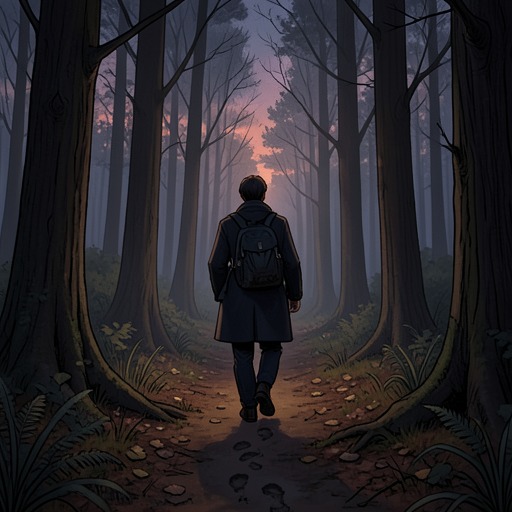
The wood is represented as dense, varied, and difficult to read. Trees, undergrowth, fallen trunks, ivy, stone walls, a river, and an old ruined tower create a landscape full of small routes and hidden places. Its apparent quiet is composed of innumerable sounds and signs of animal life. This intricacy matters to the children’s experience of it: they do not encounter a blank wilderness, but a familiar territory whose paths and landmarks they have learned to navigate. To an adult visitor, the same place can feel secretive and resistant to orientation.
The ruined tower gives the wood a visible connection to an older past. The children use its high room as a refuge, reaching it by climbing the outside wall because its staircase has crumbled away. Ivy and overhanging branches make the room seem suspended above the ground. It is a practical hiding place, but also a setting where the children bring distress and private troubles, showing how their knowledge of the wood includes places of retreat as well as play.
The Children’s Territory and the 1984 Disappearance
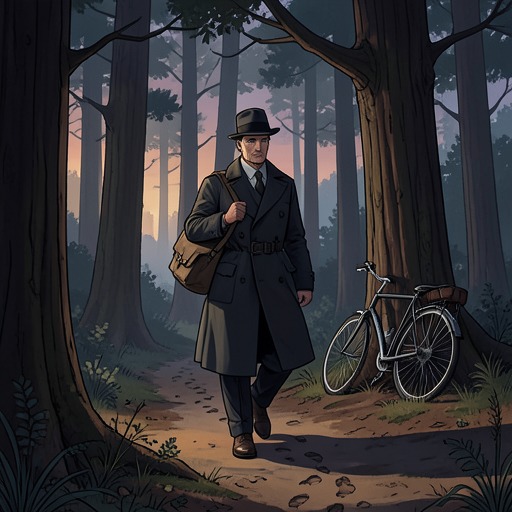
On August 14, 1984, twelve-year-old Germaine Elinor Rowan, Adam Ryan, and Peter Joseph Savage spent the afternoon in and around the estate. Witnesses had seen them playing in the road, riding bicycles, and using a tire swing. They left their bicycles in the Savages’ garden and went over the wall into the wood, where they often played and knew the area well. Peter’s mother expected him home for tea at 6:30. When none of the children returned, their parents first supposed that they had lost track of time in a game; after searching and calling for them, they contacted the police as darkness approached.
A search found no sign that the children had prepared to run away. At 10:20 p.m., a policeman discovered Adam standing against a large oak near the center of the wood. He did not respond to searchers. He was taken to hospital, where he remained nearly motionless for almost thirty-six hours and did not speak for two weeks. Blood had stained his running shoes, and his T-shirt was torn, but he had no substantial injuries. Search dogs tracked Peter and Jamie to a point near where Adam had been found, then lost the scent. The evidence establishes the stark difference between the children’s shared entry and Adam’s solitary return, without resolving what happened to Peter and Jamie.
The wood’s role as an intimate childhood domain makes that disappearance especially difficult to explain. The friends were accustomed to finding their way through it, and the adults who knew their habits did not initially assume that they would become lost. The place that had seemed legible to the children becomes the setting of an absence that neither the search nor Adam’s condition can make intelligible. For Rob, who had been Adam, the blank between entering the wood and waking in hospital becomes a defining gap in his own history.
Hidden Histories and Later Violence
The children were not the only people who used the wood as a private territory. During an attempt to recover childhood memories, Rob recalls that he and his friends sometimes watched a group of bikers in a clearing near the old castle. One remembered visit begins as spying and childish amusement. On a later occasion, the children approach the clearing and witness members of the group assault Sandra Scully. They run away; when they see her the following day, they understand that she has seen them, but none of them acknowledges the encounter. The memory connects the children’s games to adult violence without making them its cause or resolving their silence at the time.
Jonathan Devlin later describes an assault on Sandra in a clearing where he and his friends had spent time. His account places the event in a summer of long days when the group drank and used drugs. Rob’s recovered memory and Jonathan’s later account bring separate perspectives to violence in the same woodland setting. The clearing is thus not only a place recalled through children’s games: it holds an episode that the children witnessed but did not know how to address, and that adults later describe in terms of their own participation and responsibility.
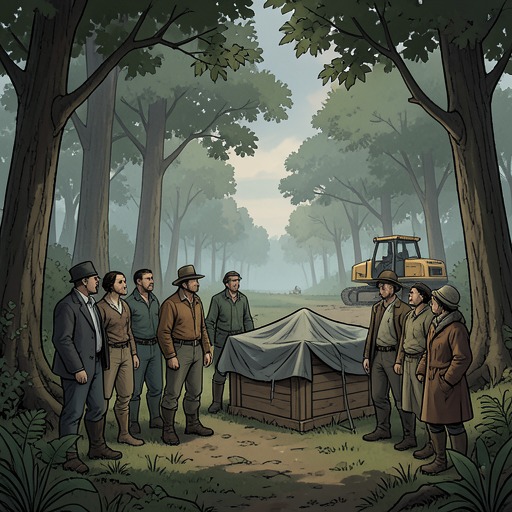
A further return to the wood comes during Rob’s investigation of Katy Devlin’s murder. By then, the original woodland has been greatly reduced. A huge archaeological field occupies the ground where the wood had stood twenty years earlier; only a strip of trees remains. The site’s trenches, soil heaps, temporary buildings, exposed stonework, and cordoned crime scene make the altered landscape at once recognizable and strange to Rob, who grew up in one of the houses beyond its wall. A broken piece of blue plastic rope, knotted around a high branch along the estate boundary, identifies itself to him as a remnant of the children’s tire swing. The small surviving object links the present crime scene to the ordinary play that preceded the disappearance.
Return, Memory, and the Wood’s Uncanny Presence
Rob’s return is more than an investigation of terrain. As he studies the altered site, he recognizes that part of him has remained in the wood even while he treated the childhood event as belonging to someone else. He later goes back alone, carrying a sleeping bag, a torch, food, and coffee, hoping that remaining there might bring back what he cannot recall. The clearing bears fresh traces that Mark Hanly has recently visited, but Rob’s attention keeps moving between the present landscape and fragments of childhood: familiar paths, fruit trees, and the place where he remembers witnessing the assault on Sandra. The wood offers recognition in flashes rather than a coherent account of the past.
During this night in the wood, memory begins to return as a sensory and emotional sequence rather than as a clear explanation. Rob becomes rigid and shaken as he follows a fragile thread of recollection. Sounds in the dark intensify his fear, and he runs out of the trees onto the archaeological site. The episode gives the wood an uncanny agency in Rob’s experience: he feels watched and pursued, but the narrative does not establish that the landscape is literally supernatural. Its power lies in the way childhood memory, present fear, and the unresolved disappearance converge there.
That convergence also complicates the familiar distinction between hunter and hunted. Rob is a detective accustomed to investigating other people’s crimes, yet in the wood he experiences himself as vulnerable to an unknown force and to the past he has tried not to remember. In another episode, Damien Donnelly explains that he carried Katy’s body toward the site but saw a light in the wood and became frightened, leading him to take her back to the sheds. The wood remains adjacent to the investigation’s physical locations and shapes a consequential decision, even when what Damien sees is not explained.
The novel’s later account of Rob’s condition gives the wood an enduring but unstable place in memory. After months of isolation, he finds that the memories he had recovered during the investigation—including Peter, Jamie, the bikers, Sandra, and the wood itself—have become remote, like scenes from films or stories he has been told. He retains only one image of himself and Peter in the Savage family’s garden. The wood therefore remains central even when its details disappear again: it is where Rob’s childhood knowledge, his friends’ disappearance, his encounter with witnessed violence, and his adult investigation meet. Its transformation from a broad woodland into a narrow remnant beside the dig mirrors that loss, leaving visible fragments but no complete route back to what happened.